Answer in 30 seconds
Braze is putting AI decisioning, journey creation, conversation, data activation and operational control into the same delivery workflow. Fuse recommends one bounded decisioning pilot, clear message limits and a measured conversion outcome.
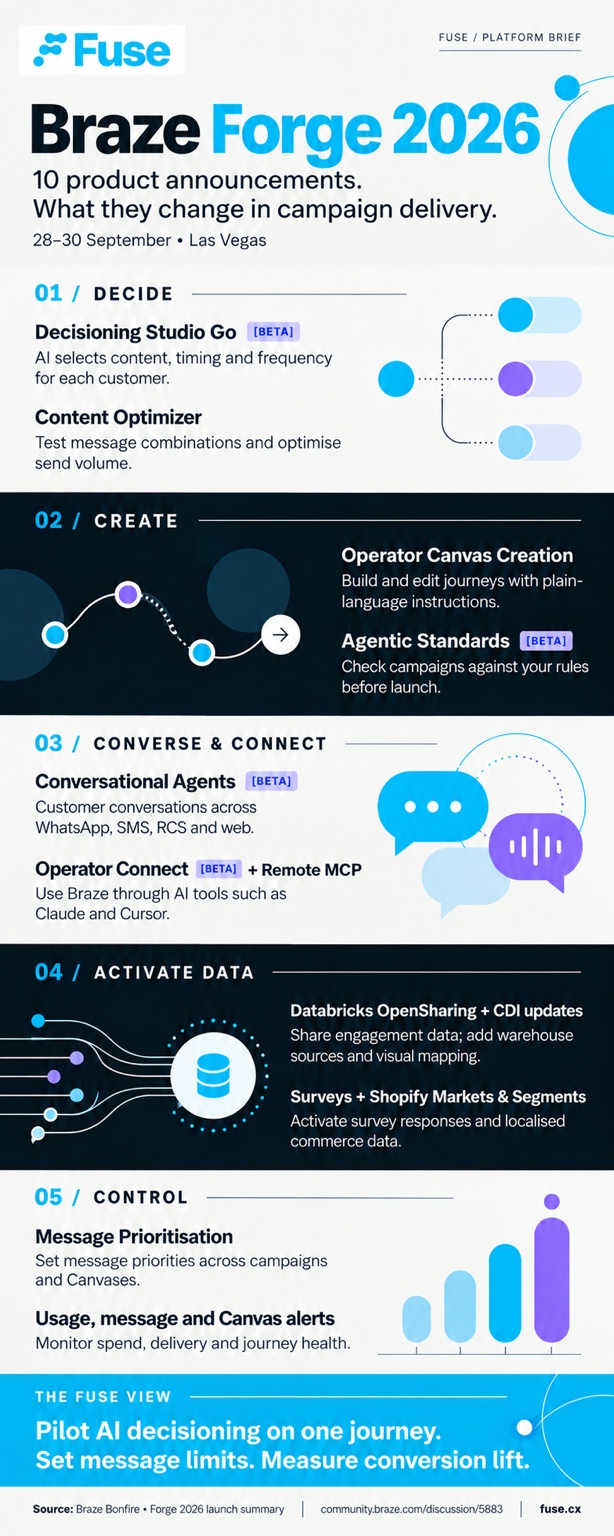
Braze Forge 2026 brought ten product announcements across decisioning, creation, conversations, data and control. This is the short map of what changes in campaign delivery.
Decisioning moves into the journey
Decisioning Studio Go, in beta, selects content and send timing for each customer in recurring programmes. Content Optimizer tests message combinations and shifts sends towards those that perform well. Teams still need to define the goal, the variants and the limits before optimisation starts.
Building gets faster; review must keep pace
Operator can build and edit a Canvas from plain-language instructions. Agentic Standards, in beta, lets teams define review rules for campaigns and Canvases. This changes the quality-control task: make the rules specific, test them against known failures, and keep a human owner for launch.
Conversations and tools connect
Conversational Agents, in beta, can respond across WhatsApp, SMS, RCS and web using approved knowledge and customer context. Operator Connect, also in beta, and the Remote MCP Server bring Braze into tools such as Claude and Cursor. Access and actions still need clear permissions.
The data loop becomes shorter
Databricks OpenSharing sends Braze engagement data to Databricks without a separate ETL pipeline. CDI adds sources and a visual mapper. Native surveys can feed segments and Canvas entry. Shopify Markets and Segments carry local language, currency, pricing and audience definitions into Braze. Each change can reduce manual hand-offs, provided the source data is sound.
Control becomes an operating discipline
Message Prioritization ranks eligible messages across campaigns and Canvases. Usage, message-observability and Canvas alerts help teams catch cost, delivery and journey issues. The value depends on who responds to each alert and what action they can take.
The Fuse view: prove one decision
Start with one recurring journey that has a clear conversion event. Pilot AI decisioning there. Set message limits, exclusions and a review owner before launch. Measure conversion lift against a holdout, together with contact pressure and spend. Then decide whether the result warrants a wider rollout.
This is also a systems question. Decide where customer state lives, which data Braze may use, what an agent can change, and how outcomes return to the warehouse. The new tools make those decisions more urgent.